Low end is where most beginner beats fall apart. You can have a clever drum pattern and a hook that sticks, then play the track on a phone or in a car and it sounds thin, muddy or just wrong. Almost every time, the kick and the bass are to blame — and usually for one of a handful of reasons. None of the fixes below need expensive gear or years of practice. They need decisions.
Tuning the kick and bass to different notes
Every kick drum has a pitch, whether you have noticed it or not. A sample's fundamental might sit somewhere near G, your bassline sits in C minor, and no amount of EQ will stop that low end from sounding loose. The ear hears two low notes pulling in different directions and reads the result as mud.
You do not have to be a trained musician to sort this out. You just have to know what note your kick is playing.
Finding your kick's note
- Solo the kick and put a spectrum analyser on the channel.
- Look for the strongest peak below roughly 120 Hz. That is the body of the drum.
- Play a sine wave at that frequency, or load a tuner plugin, and nudge it up or down in semitones until it locks with the kick.
- That note is your kick's pitch. Write the bass around it, or swap the kick for one that fits the key you are already in.
Tuning the bass a fifth above the kick can work beautifully, but it has to be a choice. A clash you did not intend is the single most common reason a beat feels amateur.
Making both elements fight for the sub
A kick and a bass both trying to deliver the deepest frequencies is like two people talking over each other. Decide who owns what, then let the other one do a different job.
A short, punchy kick can be high-passed around 40 to 60 Hz so the bass takes the very bottom. A long 808-style kick wants the sub to itself, so keep the bassline an octave up, or give it a fast decay so it clears out before the kick lands. Neither approach is better. They are just different plans.
Carve, don't compete
Once you have picked a winner, make room with small EQ moves. A narrow dip of two to four decibels on the bass, centred on the kick's fundamental, does more than a heavy scoop across the whole low end. The same works in reverse: dip the kick slightly where the bass sits strongest.
Then clean up everything else. Pads, keys, guitars and vocals that are not meant to be bassy should usually be high-passed somewhere between 100 and 200 Hz. That single habit clears more space in a busy mix than any compressor will.
Never leaving a gap
If the bass plays continuously underneath every kick, there is no space for either sound to land. Bass notes that hit at the same moment as the kick feel heavier because they are not fighting the tail of the last one.
Try muting the bass on the first beat of every second bar, or write the bass around the kick instead of on top of it: kick on one and three, bass answering on the offbeats. The classic house trick of putting the bass on the offbeat works for the same reason — it gives the kick a clear window.
Sustained sub notes are the worst offenders. If a bass note rings through a kick hit, shorten it, or automate a small dip in volume just before the kick arrives. A two-decibel dip for forty milliseconds is often enough, and it is far less destructive than ducking the whole part.
Using sidechain compression as a sticking plaster
Sidechain compression — the bass ducking automatically whenever the kick hits — is a useful tool. It is not a cure for a clashing sample, a muddy arrangement or a badly tuned bassline. If you need more than three or four decibels of gain reduction to make things sit, the problem is somewhere else.
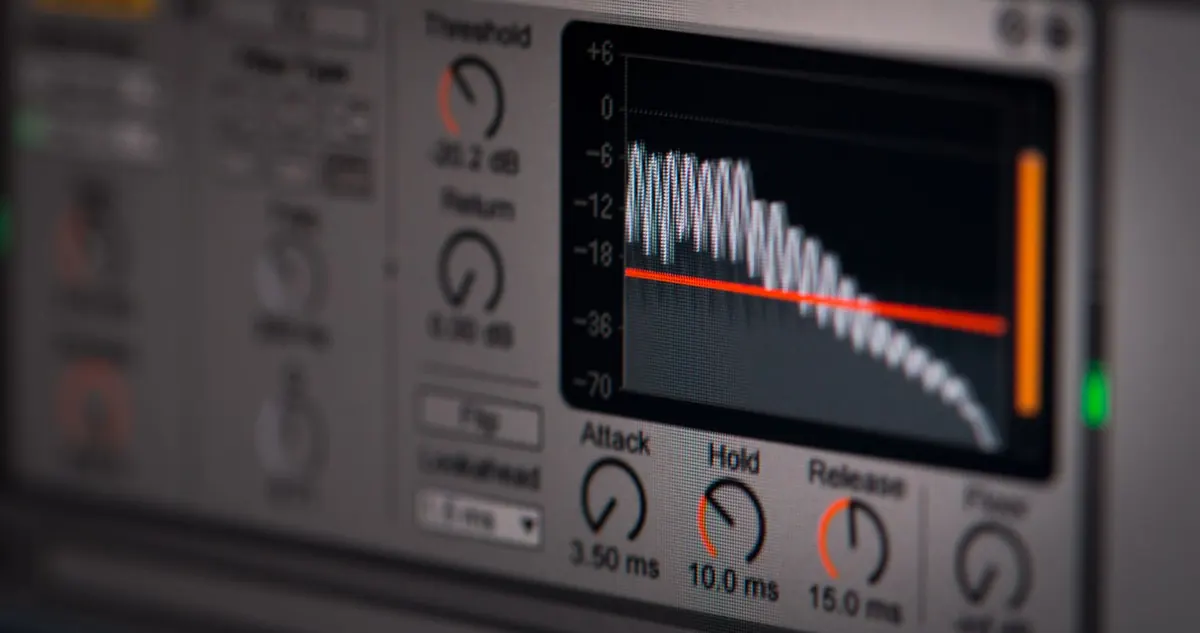
When you do use it, keep it light. A fast attack (a couple of milliseconds) catches the kick's transient, and the release should be timed so the bass is back before the next hit. At 128 bpm a quarter note lasts roughly 470 milliseconds, so a release somewhere in the region of 80 to 200 milliseconds is a sensible starting point. Trust your ears over the maths.
You can also skip the compressor entirely and draw the ducking in by hand. A short volume dip on the bass track, placed exactly where the kick lands, gives you total control and none of the pumping that heavy sidechain produces. It takes longer, but on a four-bar loop it is ten minutes of work.
Mixing loud and on one system
Turning the volume up makes bass feel impressive. It also lies to you. At a moderate, conversational level your ears are far more honest about balance, and low-end problems show up quickly.
Check your mix in mono. If the kick thins out or the bass loses weight, you have a phase problem between your layers, and it will only get worse on a club system or a phone. Then check on a small speaker with no sub at all — if the bassline still reads as a musical part there, it has enough mid-range character to survive anywhere.
Compare against a commercial track in a similar style, turning the reference down until it matches the rough loudness of your own mix. Loudness differences fool you into thinking a mix is better than it is.
One sensible note on your ears: keep headphone levels moderate and take breaks every hour or so. Long sessions at high volume can cause permanent hearing damage. If you notice ringing after a session, or you are worried about your hearing, speak to your GP or an audiologist rather than pushing through.
A quick low-end checklist
Before you call a beat finished, run through this list:
- Kick and bass agree on pitch — same root note, or a deliberate interval.
- Only one element owns the sub; the other gets out of the way.
- Everything that is not kick or bass is high-passed, usually between 100 and 200 Hz.
- The bass leaves a gap where the kick lands.
- Sidechain is doing a few decibels of work, not ten.
- The mix holds up in mono, at low volume, and on a small speaker.
Fix one thing at a time and bypass it as you go. If the beat sounds better with your clever new plugin switched off, leave it off. The goal is not a perfect-looking curve on an analyser — it is a low end that still makes sense on a phone, in a car and on a friend's speakers.
Photo: Caraudiocompl / Pixabay